
@godsandcroziers@pagan.plus
·
May 05, 2026
The Gods and Their Croziers
@godsandcroziers@pagan.plus
A project to apply comparative mythology to Celtic-Christian Hagiography to undo the layers of "Interpretatio Christiana" that rendered the Celtic gods into Saints. Focusing mostly on the Irish saints and Gods, but with wider relevance to how we understand Celtic, Norse, Mediterranian, Ossetian, Iranian, and Indian traditions.
pagan.plus
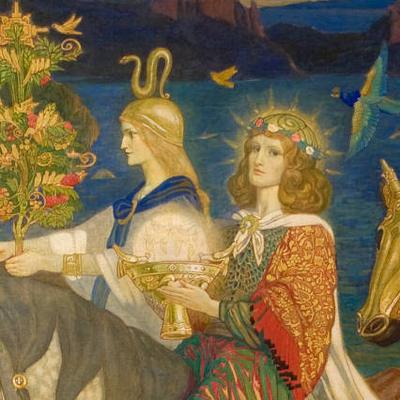
As promised: today's issue of The Gods and Their Croziers is my second issue on the #Morrigan. Like my first Mórrígan issue it's a mess of cross-identifications, cosmic thoughts, and speculations about the wider role of the Mórrígan outside "war".
It's built around an observation, that several fairs in areas associated with the #Mórrígan, and feast days of several local saint versions of her, are held at or near #Bealtaine / #Beltane
But, it leads to interesting observations that suggest further identifications for her throughout myth and folklore: from Clídna to Aífe to Crédhe of the Yellow Hair.
As ever: this is not ”all" the Mórrígan, and it's not counter to what we already knew.
May 6th: The Mórrígan, Queen of Summer, as Sts. Inghean Bhuidhe & Cróbh Dearg
https://buttondown.com/godsandcroziers/archive/may-6th-morrigan-queen-summer-inghean-bhuidhe-crobh-dearg/
7
3
9
@godsandcroziers@pagan.plus
·
May 05, 2026
The Gods and Their Croziers
@godsandcroziers@pagan.plus
A project to apply comparative mythology to Celtic-Christian Hagiography to undo the layers of "Interpretatio Christiana" that rendered the Celtic gods into Saints. Focusing mostly on the Irish saints and Gods, but with wider relevance to how we understand Celtic, Norse, Mediterranian, Ossetian, Iranian, and Indian traditions.
pagan.plus
One of the theories I explore addresses the question: why are these two Munster-Mórrígna found in seasonal *triples* celebrating #imbolc, #Bealtaine, and #Lughnasa, but not #Samhain? And the answer, I think, is that in these guises they represented stages of the Corn: Planting, Ripening, and Harvest.
That leaves one season and one goddess, but we already have a good idea: the last sheaf of the corn was woven and kept respectfully for next year, and called the #Cailleach - the same name as the goddess of Winter.
That seems to put the Mórrígan in the position of being the representation of the "Maturing/Ripening" stage of the Corn. Planting should be done by Bealtaine! Planting is Brighid's business! :)
4
2
1
@Ciaraioch@mastodon.ie
·
May 01, 2026
Ciara | Ciaraíoch 🎨
@Ciaraioch@mastodon.ie
Hittin' peak dhera. [Cartoonist/Illustrator/Doodler] For any and all work-related queries, email 📨 ciaraioch.art@gmail.com (Email only as DMs often get lost)
mastodon.ie
Happy Lá Bealtaine - the swallows have arrived and summer's on the way 🔥
Prints: https://www.ciaraioch.com/artprints/p/bealtaine-a4-fine-art-prints
#Art #MastoArt #MastoDaoine #Ireland #FediGiftShop #Bealtaine
95
6
85
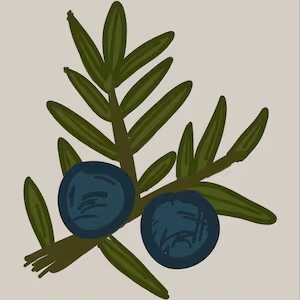
On Bealtaine eve in Ireland, primrose was scattered across doorways because fairies couldn't cross it. Butter, milk, and the household's luck were all at risk. The Good Neighbors became especially active at this time of year, and certain protections were essential.
Food and drink were left out as offerings. Doors and windowsills were lined with primrose. Cattle were watched closely.
#IrishFolklore #Bealtaine #FolkMagic #Paganism
https://juniperdivination.com/irish-bealtaine-traditions
6
0
4
Some Bealtaine customs trace to the 9th-century Irish record. Sanas Cormaic describes two fires and cattle driven toward them. Some came from English May Day traditions absorbed over centuries. The Green Man was coined as a term in 1939. Handfasting has Old Norse origins.
Each custom is traced to its actual source using Sanas Cormaic, Kevin Danaher, and Ronald Hutton.
#IrishFolklore #Bealtaine #Paganism #FolkHistory
https://juniperdivination.com/history-of-modern-beltane-traditions
4
1
2
@godsandcroziers@pagan.plus
·
Apr 28, 2026
The Gods and Their Croziers
@godsandcroziers@pagan.plus
A project to apply comparative mythology to Celtic-Christian Hagiography to undo the layers of "Interpretatio Christiana" that rendered the Celtic gods into Saints. Focusing mostly on the Irish saints and Gods, but with wider relevance to how we understand Celtic, Norse, Mediterranian, Ossetian, Iranian, and Indian traditions.
pagan.plus
I should add; specific points in the calendar are rarely associated only with one God or God-narrative. So when I say that Bealtaine is the Mórrígan Festival, I'm referring to the Festival Traditions and Seasonal Associations.. but there are other things that mythically happen on Bealtaine Eve/Day that have little to do with her.
Nevertheless - these Saints of Bealtaine look very like Mórrígans, and we know at least some ancient festivals were held on sites associated with her, too. #Walpurgisnacht too has many traditions in common with Celtic #Beltane / #Bealtaine / #MayDay traditions, and I see the hallmarks of the Mórrígan's parallel mythic roles there too. I'll try to do those justice in the upcoming May 5th issue..
6
0
1
You've seen all posts